The rise of offshore floating photovoltaic (PV) power plants has opened up a new blue ocean for solar energy applications.
2025/12/6
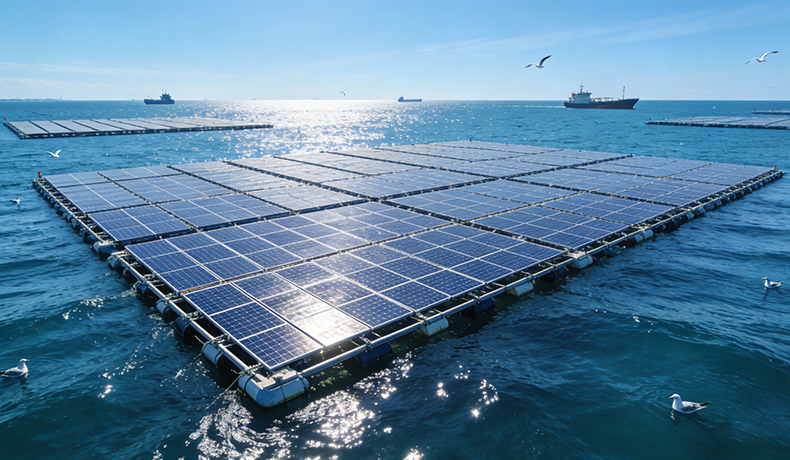
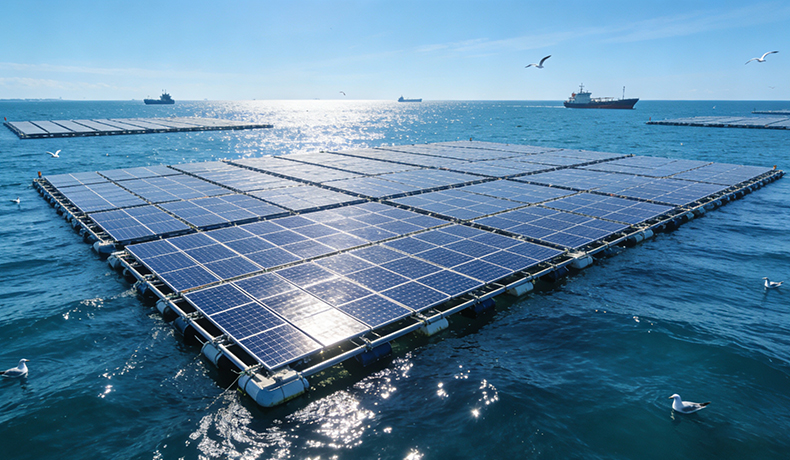
Faced with increasingly tight land resources and the continuous growth in demand for clean energy, offshore floating photovoltaic (PV) power plants, leveraging their unique advantages, are rapidly advancing from technological demonstration to large-scale application, opening up a promising new field for the global solar energy industry. This innovative model of deploying PV power generation systems in offshore waters, lakes, reservoirs, and other water bodies effectively addresses the bottleneck of developing large-scale PV projects in densely populated and land-scarce areas, becoming an important direction for the diversified layout of renewable energy.
The core value of offshore floating PV lies in its efficient utilization of space resources. By installing PV arrays on the surface of vast water bodies, it achieves compatible coexistence between power generation and the original functions of the water areas (such as fisheries, shipping, and water source protection), significantly enhancing the economic and ecological benefits per unit space. At the same time, the natural cooling effect of water can effectively reduce the operating temperature of PV modules, resulting in a certain improvement in power generation efficiency under the same conditions compared to ground-mounted or rooftop power plants. In addition, in arid or semi-arid regions, PV panels covering reservoirs or lakes can also reduce water evaporation, playing a positive role in assisting water resource protection.
Globally, many countries and regions are actively promoting the implementation of floating PV projects. China has launched large-scale offshore floating PV demonstration projects in Xiangshan (Zhejiang), Wendeng (Shandong), and other places, exploring technical solutions under complex marine conditions. Singapore and South Korea have built practical power plants using offshore or reservoir resources, while the Netherlands has carried out innovative experiments based on its abundant water area conditions. Southeast Asian countries are accelerating development by relying on lake and reservoir resources. These projects cover different stages from technical verification to commercial operation, continuously accumulating valuable experience in design, construction, and operation and maintenance.
The development of this field still faces a series of technical challenges. The high salt spray, strong corrosion, and complex wind, wave, and current conditions in the marine environment place extremely high requirements on the durability of floating body materials, the reliability of mooring systems, and the sealing performance of electrical equipment. Designing floating structures and anchoring schemes that are typhoon-resistant, corrosion-resistant, long-lasting, and cost-effective is crucial. At the same time, the complexity, cost, and safety of offshore construction and operation and maintenance need to be continuously optimized. Grid connection, long-term impact assessment on marine ecosystems, and the improvement of relevant standards and specifications are also important issues for the healthy development of the industry.
Despite the challenges, the market prospect of offshore floating PV is widely optimistic. It has enormous application potential in regions with limited land resources but excellent lighting conditions, such as coastal cities, island areas, and large reservoirs. With innovations in floating body materials and structural design, advancements in corrosion-resistant technologies, cost reductions brought by large-scale production, and the continuous maturity of project experience, the competitiveness of offshore floating PV is expected to be continuously enhanced. At the policy level, many countries have begun to include this technical route in their energy plans, providing directional guidance for its development. As an important supplement to traditional PV application scenarios, offshore floating PV is expected to occupy a unique position in the future energy landscape, offering a new path choice for the global energy transition.

SG Solar copyright {Disclaimer}
Region contact:Charles McGlinchey
Email:charlie.mcglinchey@sungrow-re.com
Phone number:0484 296 535
Address: Chadstone Tower 1 Level 8, 1341 Dandenong Road, Chadstone, VIC, 3148
Technical Support:IBW(www.ibw.cn)